

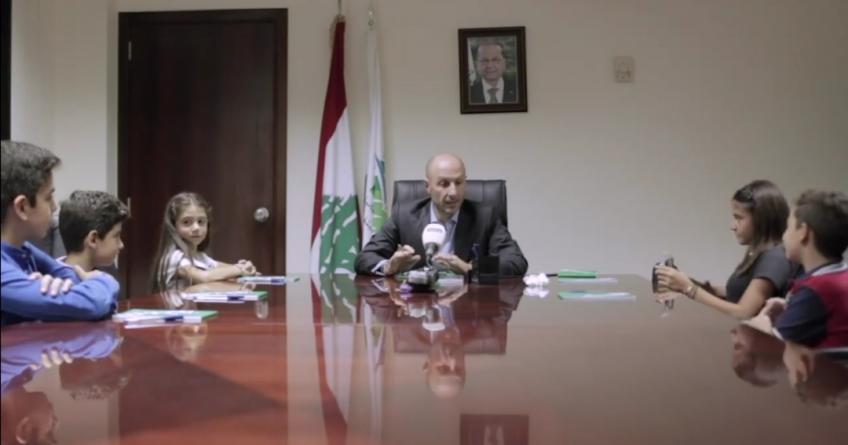
“Fish have a lot of benefits for kids, but we children are eating fish full of microplastics. What are you doing to us? Why aren’t you protecting us?” said Belicia, a seven-year-old girl, to the then-Minister of Environment in Lebanon. “Lebanon is our country and we won't allow grownups to mess with it.”
She is one of five children who met with the Minister to press him on a major threat to the environment and public health in the country—plastic pollution.
They gave him an earful.
Karl, age 8, said, “Do you know that 80 percent of our litter are made up of plastic?” He added that while plastics are so useful, they are also impossible for nature to completely break down. Karl tries to be a role model in front of his friends at school by not littering.
According to UN Environment, a staggering 8 million tonnes of plastic end up in the world’s oceans every year. Much of that plastic is disposed of in rivers, which then serve as conduits to the ocean. Most plastic items never fully disappear; they just get smaller and smaller. Many of these tiny plastic particles are swallowed by farm animals or fish who mistake them for food, and thus can find their way onto our dinner plates.
Belicia, Karl, and other children won’t stand for it. This group of children is part of an eco-committee created by Public Matters Lebanon, an NGO that works on developing children's empathy and leadership skills at a young age. The organization collaborated with the UN Information Centre in Beirut (UNIC Beirut) and other partners to launch #Reduce—a campaign to promote eco-friendly habits and reduce plastic waste and pollution.
Since kids are the ones who will be most affected by plastic pollution, they are put at the front of the campaign, which is why they met with the Minister.
“It’s very dangerous that Lebanese people use on average one plastic bag per day, and this adds up to around 4 million plastic bags per day,” said 12-year-old Makram, an activist by nature.
“We wish you could put your hand in ours in order to find a solution,” added Maria, age 14, another member of the eco-committee. “We will not remain on the margins.”
As part of the #Reduce campaign, these children are taking part in workshops on getting involved in social, environmental, cultural, and educational issues. They proposed these solutions to the Minister, including:
- Issuing decrees prohibiting the use of plastics in all ministries in Lebanon and stopping schools from selling food in plastic containers.
- Reducing plastics by installing refill stations for laundry detergents in supermarkets.
- Initiating a children’s eco-committee in Lebanon, with representation from all Middle Eastern countries.
Aiming to reach the largest possible number of Lebanese people, the campaign kicked off in a short video that was screened for a month in cinemas and on TV stations, as well as on social media and electronic billboards. The video shows Lebanon’s waters polluted as a result of the excessive use of plastic and the lack of policies to address the growing waste crisis in the country.
The young ambassadors’ role is to build relationships with our children from diverse background and develop their leadership skills. Aside from the children’s involvement, the #Reduce campaign also includes a plan for women to manufacture eco-friendly bags- that will cut down on waste and create jobs for women.
“In a world that is increasingly lacking empathy in all of its institutions, the only hope we have is our children who, someday, will make responsible decisions as adults,” said Julie K. BouChakra, president of Public Matters Lebanon.
“Children’s innocence and devotion have a great impact on people,” adds UNIC Beirut Director Margo Helou. There is no Planet B; that is why teaching children healthy eco-habits will make this world a better place.”
Back at the meeting the Minister, the children pressed for a commitment: “It’s very nice for the officials to lead by example, especially for children,” they said. “Are you ready to work with us?”
The then-Minister of Environment, Fady Jreissati—who has since been replaced—was impressed by the children and their enthusiasm. “I am so happy to be with you. Meeting with you is one of the best things I’ve done in my life,” he said. “All those older than you should be ashamed of themselves because they failed to do what you’ve done.”
He endorsed and signed the solutions.
